

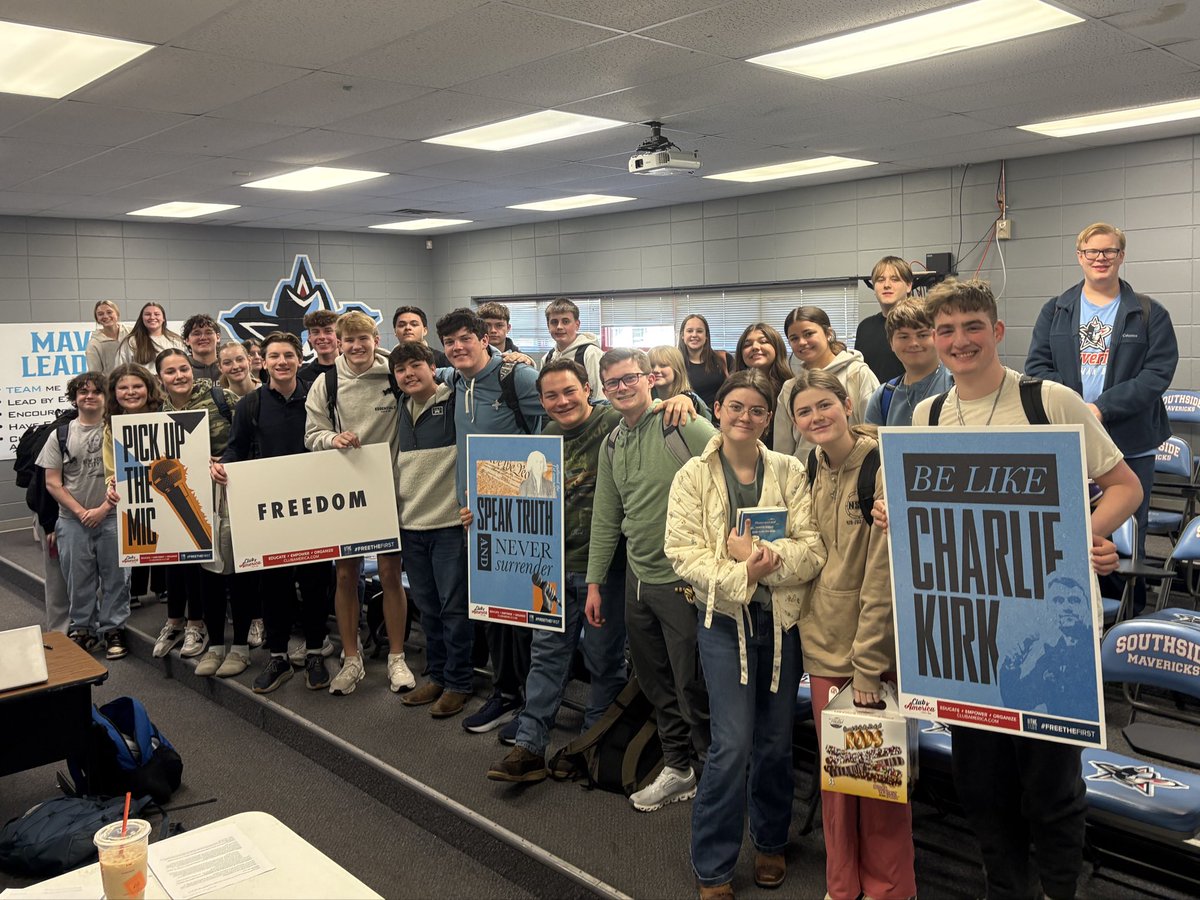
Clubs are a pivotal part of the high school experience as they bring together people who share the same hobbies or beliefs. Southside hosts 46 clubs, including the are Gay-Straight Alliance club, Debate and Forensics Club, Partners in Christ, Model United Nations, and many others. Recently, a new club began at Southside representing Turning Point USA.
Turning Point USA is an American nonprofit organization that advocates for conservative politics on high school, and university campuses. Founded by the late Bill Montgomery and Charlie Kirk in 2012, focusing its initiative on young college and high school students. Since Charlie Kirk’s assassination in September 2025, the social environment has become more tense as young adults begin to question TPUSA’s values and messages as well as the current administration’s actions. Since President Donald Trump took office, there’s been a significant increase in TPUSA chapters in Arkansas schools, beginning at nine to forty-six, mainly due to the club’s support of the President. Sophomore Luke Southerland founded Southside’s chapter and Mr. Curtis is the teacher sponsoring the club.
During their interest meeting on Tuesday, February 3rd, a discussion regarding many topics occurred. The purpose of the club, as stated by Southerland, is to “continue the legacy of Charlie Kirk, share our conservative and Christian beliefs, and to have respectful debates with others.”
According to Southerland, anyone can join and bring their own religion and political beliefs, but the group will predominantly focus on conservative and Christian values. Helping and sponsoring the club is a real TPUSA employee, a young woman named Allison. During the meeting, Allison discussed her background and stated she got hired by TPUSA last August, after graduating from the University of Arkansas- Fayetteville, in May.
“Absolutely. We think the club will encourage conversations between students,”she replied to a question about whether the club will affect the student body.
Continuing, she stated that having a community of “ like-minded people that are able to come together here and learn about new things builds a great foundation in high school. I wish I had joined in high school or college because it would’ve been very beneficial to me.”
The discussion at the meeting included the topic of debates. Mr. Curtis commented on the topic of debates, but didn’t state when or where said debates would take place.
“After research and practice, the club will hold open discussion days where all students are invited to discuss their views on a given topic,” he stated via email. He didn’t elaborate further.
When asked why he thinks it’s important to involve politics in higher education systems, he stated, “I think since politics is often divisive, it would be worth the effort to try and develop relationships based on respect. Those will only come through attempts to talk and learn.”
Southerland also had a few comments about the club. Southerland, created this group with a fellow peer named Molly Humphrey.
When asked why the two of them started the club, Southerland stated, “Molly might have a different reason than me but I have always been a big person of faiths and beliefs. Even though some people might not want to talk about this stuff, it needs to be brought up.” Continuing, he claimed, “I think talking and sharing beliefs is a good thing because people need to know that they believe what they believe based on themselves and not just what their parents believe.”
Southerland also hopes that the club will last and impact his peers. “I think it is a great way to share beliefs and also learn about different beliefs. I hope that something that will come out of this club is that people can learn life skills on how they can think on their own without just believing in what they have always been told. I do think that this club will last a good while and I hope it does.”
About debates, Southerland had a more in-depth and knowledgeable answer about when the debates will take place and what topics may be discussed.
Southerland explained, “Right now for debates we plan on doing them maybe once a month. We want to have a topic that we will be going over and we want to have people come up and talk with us over the matter if they would like to.”
Both Mr. Curtis and Southerland were asked how the club plans to challenge opposing student opinions, as debates will involve controversial topics.
“We are not going to have debates in the classic sense of the word in that there will not be an official winner and loser. I am sure that discussions may have emotions but I think that students will quickly learn how to calm down, respect each other and learn.” Mr. Curtis said.
Southerland said something similar to Mr. Curtis’s response, citing the importance of having civil debates between students.
“We want to take everyone’s opinions seriously and we want to be respectful and kind when talking about whatever it is. There really is something both people can take out of a debate and think on if done correctly and civilly.” Southerland said.
Many students have spoken out, primarily on social media, against the formation of the club, stating that the club is not needed at Southside High School, as it does not produce a helpful or peaceful agenda. The fear is that a conservative club in the high school environment can lead to drama among students, as many of them do not follow these beliefs. Some students, one of them being Eliana Santos, a sophomore, claim that this club is “giving people a reason to hate Southside” and that the people involved are supporting “a convicted felon,” referencing President Trump.
“There is no reason why we should have this type of organization in a public institution that spreads hatred and so much conflict…this club has done nothing but divide our school and cause problems between the people around us.” Santos continued.
On one side, there are students who continuously voice their dissatisfaction, while the students in the club believe that it is necessary. There has to be a middle ground that students can come to, so our environment does not become hostile. With productive conversation, changes can be made.