

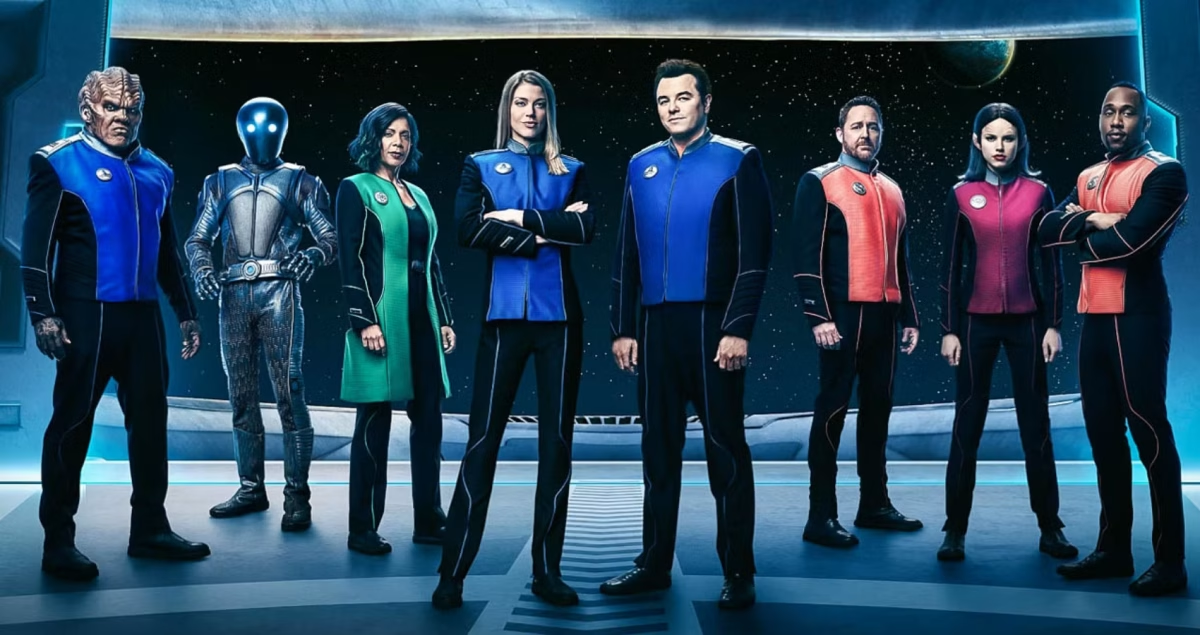
The Orville, a Sci-fi comedy/drama that is set in the 25th century, written by Seth Macfarlen, aired on Fox on Sept 10, 2017. It follows Captain Ed Mercer (Seth Macfarlen) after his bitter divorce with his ex-wife, Kelly Grayson (Adrianne Palicki). However, after his divorce, he gets command of his own ship, The USS Orville. Mercer get his best friend, Gordon Malloy (Scott Grimes) as his helmsman along with Dr. Claire Finn (Penny Johnson-Jerald), Bortus (Peter Macon), an alien from a single-sex species, Isaac (Mark Jackson), an artificial life-form from a machine society, navigator John Lamarr (J Lee), Alara Kitan (Halston Sage), a young, inexperienced security officer. Just before Mercer and his crew leave Earth’s orbit, he discovers that his ex-wife, Kelly, will be his Commanding Officer.
Season one follows Ed navigating a mid-level exploration cruiser, the USS Orville, while working alongside his ex-wife, Kelly, who is assigned as his Commanding Officer. The season focuses on the crew handling various ethical dilemmas, alien encounters, and personal issues, blending humor with optimistic sci-fi, ultimately showing that Ed and Kelly are stronger together as a command team. The main conflict for the whole crew as a whole are the Krill, a vicious and xenophobic species. Ed and Gordon even disguise themselves as Krill to sneak onto their ship to gather information, almost getting caught in the process.
The rest of the crew also deal with their own complex stories, like Bortus after he discovers that his child was born a girl, which is heavily disgraced on his home planet, Moclus. This plot point goes on for two episodes as the rest of the crew try to convince Bortus and his mate that their child, Topa, is perfectly fine as a girl. However, they gave Topa surgery to make her a boy when he was just a few days old. Alara, a Xelayan, struggles with her duty to her home planet while being away from her family, who’s family is very against her being on the Orville. The show often tackles issues with a “Planet of the Week” structure, such as a planet being governed by a popularity-vote justice system, and a planet that ended up seeing Kelly as a god after she helped a hurt little girl. The crew established themselves as a competent unit by the end of the season, setting up for deeper interstellar politics and more complex ethical challenges in subsequent seasons. The first season stays more to the comedic side while still dealing with serious topics that occur in the real world. However, as the show progresses, it dives deeper into more of the serious drama with comedic side relief characters.
Season two shifts from comedy-focused sci-fi to a more dramatic, character-driven narrative, highlighting crew relationships, moral dilemmas, and an existential threat from the Kaylon, a new threat that causes advanced problems for the crew. Major storylines include Isaac’s artificial humanity, Kelly’s past haunting her future, and the crew battling a massive Kaylon invasion, which causes Issac to betray the crew.
The most significant plot point in this season had to do with Isaac, the artificial intelligence that works on the ship. His creators, the Kaylon, view biological life forms as inferior and launch a full-scale attack on Earth. This attack makes the crew form an unlikely alliance with the Krill to defeat the Kaylon through a two-part episode. Other than the Kaylon threat there is more character building between Ed and Kelly.
Ed seeks to rekindle his relationship with Kelly, but she shuts him down and moves on with another crew member. There is also a major crew change in the middle of the season. Security Chief Alara Kitan departs back to her home planet after she becomes sick from being away from her planet’s atmosphere for too long. Kitan is then replaced with Talla Keyali (Jessica Szhor), who is also Xelayan. There is also a short romantic storyline with Dr. Finn and Issac, which has him attempting to comprehend human emotions. Helmsman Godron Malloy struggles with personal growth and his professional purpose while he tries to take the commander test. In the episode leading to the finale, “Tomorrow, and Tomorrow, and Tomorrow,” an accidental time experiment brought a younger version of Kelly to the future, causing her to reject a first date with Ed. This creates a time paradox that resets their relationship dynamic. The season finale, “The Road Not Taken,” resets the timeline after Kelly’s younger self complicates the present, leaving Ed and Kelly’s relationship in a new, uncoupled state. This season does more character building and dynamics, which made the departure of Alara more emotional. It leans more serious rather than comedic plot lines with season one. They also dealt with time traveling, which was hardly mentioned in season one, however it was good character development for Ed and Kelly.
Unfortunately, after season two was done airing, Fox had to drop the show due to the increasing production schedule. But Fox and Seth Macfarlane came to an agreement to let Hulu pick it up for season three. Hulu caused season three to have a massive visual budget upgrade along with hour-long episodes. Hulu also gave it a new name, The Orville: New Horizons, which aired June 2, 2022.
Season three offers longer, deeper, and more serious sci-fi stories focused on themes of coexistence and trauma. Key arcs include integrating Isaac back into the crew, the tragic death of Ensign Burke, and an alliance between the Union and Kaylon against the Moclan/Krill alliance, concluding with a wedding. After his betrayal in season two, the crew struggles with Isaac’s return as a crew member. Ensign Charly Burke (Anne Winters), a new navigator, resents him deeply after she lost a friend during the Kaylon attack. After the crew faces the emotional fallout, Isaac attempts to deactivate himself but Burke brings him back. While the bigger picture in this season is the Kaylons attacking, there is a storyline with Topa, Bortus’ child, where she discovers her gender surgery from when she was a baby and gets surgery to turn back into a girl. Moclus cut ties with the union in a later episode due to their political views. The writers wrote this during a very heavy political time for transgender people and the episode dove deep into the politics during this time frame. The season climaxes with a massive space battle where the Union and the Kaylon come together to defeat the alliance between the Krill and Moclan. Burke, who possesses four-dimensional vision, grows from despising Isaac to sacrificing herself at the Battle of Draconis 427, using a weapon to save the Kaylon. Her sacrifice pivots the Kaylon to seek peace with the Planetary Union. The season ends with a celebration, as Dr. Finn and Isaac get married. The episode explores the uncertainty of the future for the crew and the Union.
The first two seasons had such a nice charm to them when it came to the comedy and the budget production. Some of the lower quality visuals is what gave those seasons a nice allure that still made it enjoyable to watch. When watching season three you can clearly tell that there was a huge budget increase and there wasn’t as much comedy, which is never a bad thing. There were still funny moments with the comedic relief characters. The last season featured more drama than comedy. But there are still unfinished plotlines from season three that will hopefully be completed in the next season.
As of April 2026, Hulu has not officially renewed The Orville for a season four, but creator Seth MacFarlane confirmed in March 2026 that the new season is written and is awaiting scheduling. While actor Scott Grimes reported in 2024 that filming might begin in early 2025, industry updates suggest a potential release date in 2027 if production ramps up in early 2026.