

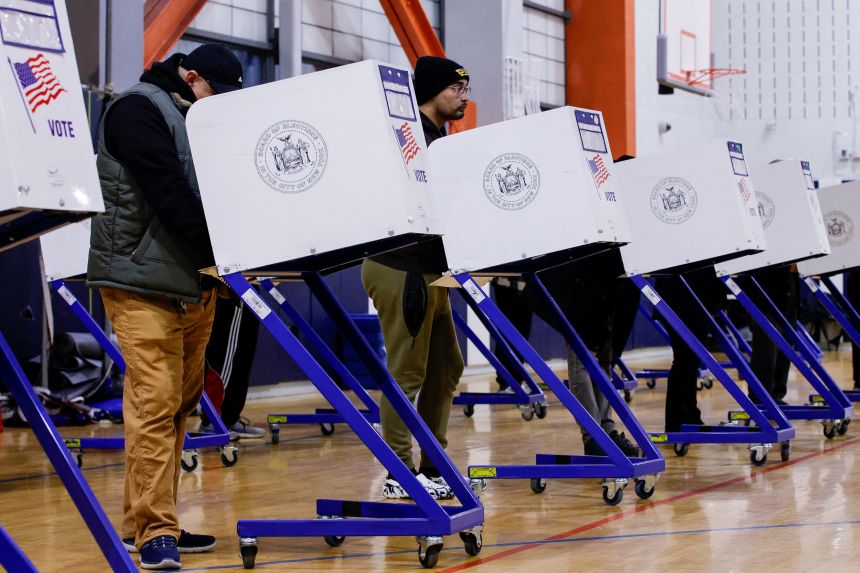
This past Tuesday, November 4, Americans across the country voted on key issues, resulting in upsets in elections in multiple states. Going into Election Day, there were four main races the country was watching: New York City’s Mayor, California’s Prop 50, and New Jersey and Virginia’s governor. In an unexpected sweep, the Democratic party scored victories in all four main elections, as well as in other important elections, such as the race for seats in the Virginia House of Delegates and Pennsylvania State Supreme Court. Further, in primarily red states such as Mississippi and Georgia, Democrats continued to outperform, breaking the GOP’s Mississippi House supermajority, and flipping two seats on the Georgia Public Service Commission. This overperformance of Democrats could represent a change in trust of the citizens for the current administration, as well as provide insight into future moves both parties could make, in preparation for the 2026 primaries.
One of the most watched elections of this year was the race for New York City Mayor. The candidates included former Governor, Democrat Andrew Cuomo, who, after losing in the primaries, ran as an independent, facing opponents Curtis Sliwa, a member of the Republican Party, as well as Zohran Mamdani, a Democratic Socialist. At the end of the night, Mamdani was elected the new Mayor of New York City. This was a historic win for Mamdani, becoming the first Muslim, first New Yorker of South Asian descent, and first African-born mayor. Mamdani ran on a platform based on putting New York City first, focusing on making the city more affordable through bringing down the price of rent, fare-free buses, and raising the corporate tax rate. The Democratic candidate held an extra 180,000 votes over both Cuomo and Sliwa in his election night victory.
“Thank you to the next generation of New Yorkers who refused to accept that the promise of a better future was a relic of the past…This city is your city and this democracy is yours, too,” Mamdani said in his election night address.
Another closely watched issue on election night was California’s passing of Proposition 50. This amendment to the California State Constitution allows the state to redistrict to gain up to five seats in the U.S. House of Representatives. This measure was put to vote in order to negate the redistricting recently done by Texas, which gained the state five seats in the House of Representatives and helped Republicans gain a majority. California Governor Gavin Newsom proposed the amendment in direct retaliation to this redistricting, as well as to give Democrats a majority in the House against proposed healthcare cuts and rising costs of living. California residents overwhelmingly voted in favor of Proposition 50, gaining a 64.6% majority vote.
“It was not just a victory tonight for the Democratic Party, it was a victory for the United States of America, for the people of this country and the principles that our founding fathers lived and died for,” Newsom said in his victory speech Tuesday night.
Further, New Jersey, as one of the only two gubernatorial races this election cycle, along with Virginia, also became a highly-watched election. While Virginia’s gubernatorial race held more historic implications, the New Jersey race serves as a good indicator of how voters may sway in next year’s primaries. The race ended between Democratic nominee Mikie Sherrill and Republican nominee Jack Ciattarelli on Tuesday night with Sherrill coming out on top. Sherrill, who, like many Democratic nominees of this election cycle, ran on the cause of affordability, and took 56.6% of Jersey citizen’s votes, compared to Ciattarelli’s 42.8% of voters. Sherrill’s victory represents the first time since 1961 a political party has held three consecutive terms in the New Jersey Governor’s office.
“[Lady Liberty] declares that her lamp lights the path to the golden door. That golden door is New Jersey. It always has been,” Sherrill spoke in her victory speech.
Virginia voters also headed to the polls Tuesday to vote for their governor, and between either candidate voters were creating history by electing the first female to the position. Democratic nominee and former Representative Abigail Spanberger raced against Republican candidate and Lieutenant Governor Winsome Earle-Sears for the position. The race, much like New Jersey, also serves as a bellwether for how voters will swing going into midterm elections. Virginia especially, with its consistent swings between Democrat and Republican leadership, serves as a general indicator of how voters are feeling as a result of the new administration, and how this will affect both parties in the midterm elections. In a victory by roughly 500,000 votes, Spanberger closed Tuesday night as the first female Governor of Virginia. Spanberger’s platform set its foundations in affordability, while also running on improving public education systems and improving community safety.
“They didn’t choose to call Virginia a Commonwealth by accident. They chose it to signify that our government would be based on the power of the people united for a common good. Not for a political party, not for a president, not for a monarch, but for a common good together,” Spanberger remarked during her election night speech.
Spanberger’s win, along with the many other Democratic victories, represents a shift in trust by Americans across the country away from the current administration. Currently, the President’s approval rating is on the decline, without a positive approval rating since October 22. These election night victories, as well as the various seats flipped for Democrats such as in Mississippi and Georgia, show a trend in voters away from the GOP and towards the Democratic Party as the current administration’s approval declines. Further, this election cycle could predict, if trends continue, a potential shift in the midterm elections favorably towards the Democratic Party.